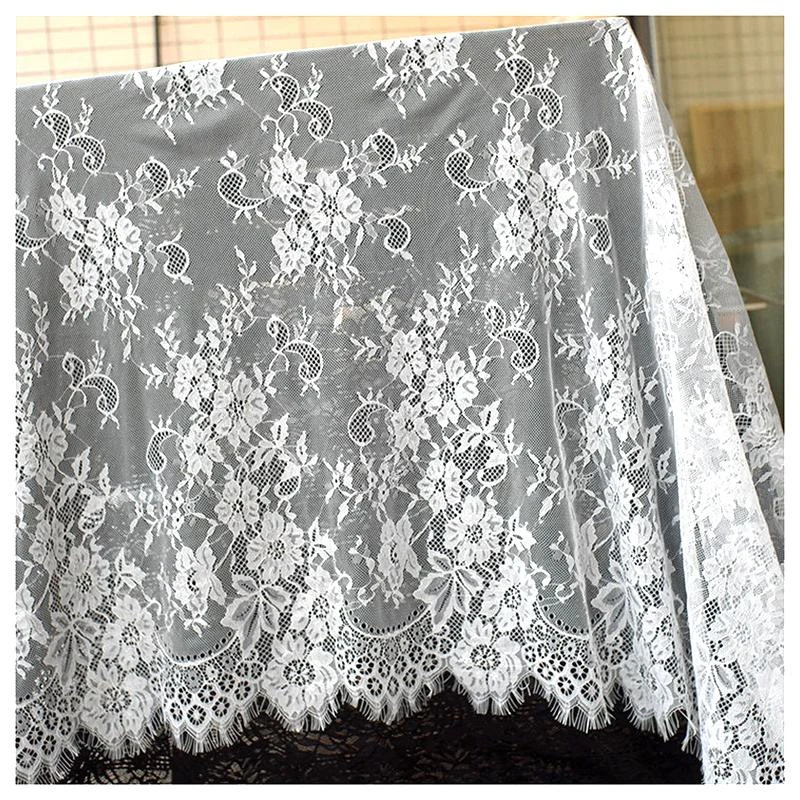
To choose lace fabric, start with the garment panel, then compare construction, edge placement, lining and cutting layout. A photograph can help you shortlist a design, but it cannot tell you whether a scalloped border fits your hem or how much usable material a purchased piece will provide.
For bridal and occasionwear buyers, the best choice is the lace that achieves the intended appearance within the garment's construction and cutting budget. Use the following comparison before selecting from the YAQIXIN lace fabric collection.
Understand the lace name and the actual construction
Eyelash, beaded and water-soluble lace are useful shopping categories, but they describe different things. An eyelash name highlights an edge effect; beaded describes surface decoration; water-soluble can refer to an embroidery production method. These labels do not fully specify the finished textile.
On a phone, swipe the table sideways to compare every column.
| Lace direction | Useful starting point | Main decision before ordering |
|---|---|---|
| Eyelash-edge lace | Necklines, sleeve ends, hems or decorative overlays where the edge is visible | Border position, motif direction, usable width and whether stretch is required |
| Beaded lace or pearl tulle lace | Bodice accents, statement panels or decorative skirt layers | Base construction, decoration density, finished weight and seam locations |
| Water-soluble / eyelet embroidery lace | Openwork panels, sleeves and occasionwear details | Whether a base cloth remains, opening size, motif connections and edge finishing |
Ask whether the fabric is knitted, embroidered on mesh or another construction. For example, TB-42 eyelash lace is listed as knitted, while YX6042-2 Chantilly eyelash lace is listed as knitted and no stretch. Neither an elegant trade name nor knitted construction establishes the stretch needed by your pattern.
Water-soluble does not mean the finished garment is intended to dissolve. Madeira's embroidery guidance describes soluble supports used during embroidery, including a lace process that leaves only embroidery thread after removal. However, commercial category names alone cannot establish whether a particular finished lace has retained cloth or mesh. Request a reverse-side photograph and a written construction description.
Choose for the garment placement
For a neckline or sleeve end, establish where the finished edge must fall before choosing an eyelash design. A beautiful border that cannot follow the intended pattern line may require a separate applied trim or a pattern adjustment. Discuss that construction with the garment maker before buying fabric.
For an all-over overlay, compare the motif at full garment scale. A large flower that looks balanced in a close-up may fall awkwardly across a bust seam, waist or centre front. Plan left and right panels together, especially when symmetry is part of the design.
For beaded bodices and fitted sleeves, mark seams, closures and high-movement areas. Ask the maker how decoration near a seam will be handled and secured. For skirts, decide whether the effect should cover the full panel or sit only near the hem. This establishes the amount and placement of decoration you actually need.
Account for borders and repeats in the cutting budget
A usable border is a limited resource. Confirm whether it runs along one edge, both edges or another direction, and ask for its height and repeat measurement. Do not assume that the photographed edge appears on every side of the supplied piece.
Request a photograph showing the full width with a ruler. Then prepare a trial cutting layout that includes:
- The location of each required scalloped or eyelash edge.
- Motif matching at visible seams and across paired panels.
- Any direction that prevents rotating pattern pieces.
- Areas reserved for appliqué, corrections or decoration near seams.
Compare cost using material consumed per garment, rather than price per yard alone. A wider fabric is not automatically more economical if its borders or motif positions restrict the layout. Avoid a fixed waste percentage until the pattern pieces and repeat are known.
Review lining, weight and movement together
Place the selected lace over the intended lining color. White over ivory, nude or white lining creates different contrast, and the lining may change how clearly the motif reads. For an illusion panel, confirm the required transparency and comfort at the actual position on the body.
Beaded lace spans very different constructions. ZST001-2 pearl tulle lace is listed with a soft tulle base and 40gsm, while the lace collection lists YX1174 at 1000gsm. These are catalog references, not interchangeable garment specifications. Ask whether the quoted weight covers the finished decorated fabric, then assess a sewn panel with the intended support layers.
YX2439 eyelet embroidery lace is listed at 250gsm and 125cm wide. Evaluate its openwork and lining needs without assuming it is entirely base-free guipure. Where a design needs both lace and net layers, the existing tulle selection guide explains the separate tulle decision.
Confirm pieces, yards and metres before comparing quotes
A piece is a supply format, not a universal length. YX6042-2 is listed as 150cm × 300cm per piece. Confirm each piece's dimensions, usable width, border position and whether adjoining pieces can be treated as continuous material.
One yard equals 0.9144 metre: ten yards provide 9.144 metres of length, not ten metres. Convert all quotes to the same unit and compare the cutting layout at the actual width. State your required quantity with its unit in the order; avoid an unqualified request for “ten lace.”
Frequently asked questions
Which lace is best for a wedding dress?
There is no single best type. Choose by panel: a visible eyelash edge, a beaded focal area or an openwork overlay can answer different design needs. Confirm the lining and cutting plan for each.
Is water-soluble lace always guipure without a base?
Do not assume so from a sales category. Ask what remains in the finished textile and review both sides of the sample. Confirm the exact construction before using a guipure description.
Can I estimate lace consumption from plain-fabric yardage?
Use it only as a starting point. Borders, directional motifs, matching and piece dimensions can change consumption. Approve a lace-specific layout before confirming the order quantity.
Ready to shortlist a lace? Send YAQIXIN your inquiry with the product reference, garment sketch, panel placement, lining direction and required quantity in pieces, yards or metres. Include the border and repeat details your maker needs confirmed so the sourcing discussion supports the actual garment.
Ready to discuss a fabric brief?
Share your intended application, a reference image or swatch, quantity, and market. We can help you compare a stock or custom fabric route before you place a bulk order.
Start a fabric inquiry